ISO Consultants in Dubai: What You Need to Know
Wiki Article
What's The Reason Uae Businesses Are Eager To Get Iso Certified In 2026
When you are in any procurement conversation in the UAE in the present and ISO certification is mentioned in the initial few minutes. What was once a nice-to-have credential for larger corporations has now become a essential requirement in construction, healthcare, logistics, food production, and technology. And the speed at which local businesses are looking to obtain certification has increased dramatically over the past couple of years.Government Contracts are Driving Much of the demand
A significant proportion of the currently being pushed comes from semi-government and government tendering requirements. A lot of public sector contracts across the Emirates have now included an ISO certificate as a mandatory prequalification certificate rather than an optional extra, which means companies without one are basically excluded from tendering before pricing or capabilities are even considered in the discussion.
International Trade Partners Expect It as a Standard
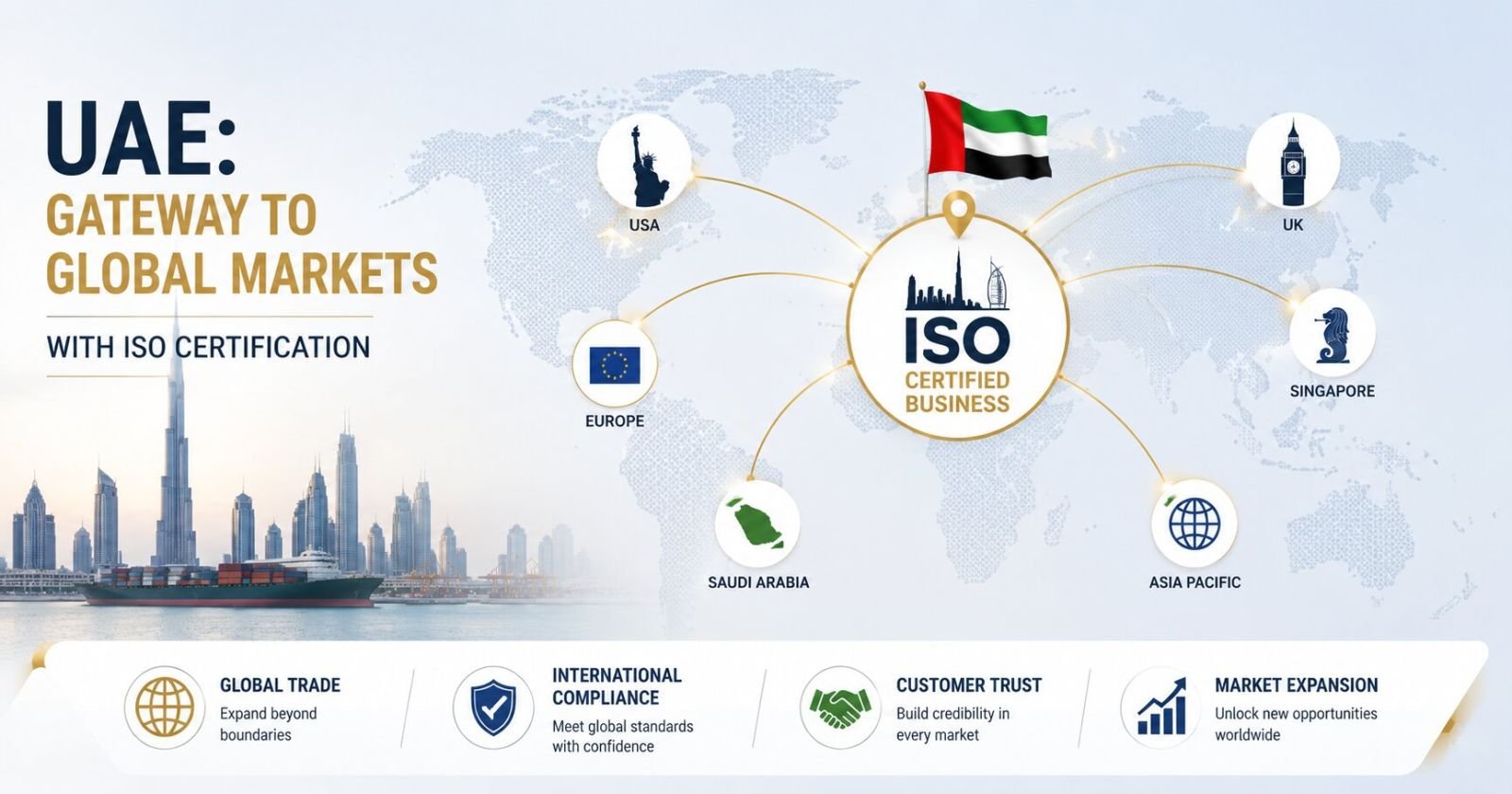
The UAE's position as a regional logistics and trade hub means that a large portion of local companies have international suppliers, and these business partners are increasingly utilizing ISO certification as a assurance rather than a distinguishing factor. It is a European or North American buyer evaluating a UAE-based supplier will often shortlist the supplier based on whether they have a recognized management certification is in place. they have a familiar benchmark regardless of how much they are familiar with the local market.
Free Zones are actively encouraging certification
Many of the largest UAE free zones have begun to offer certification as a part of their business-related setup programs realizing that certified tenants tend to have better clients and grow more effectively. This formal encouragement, coupled with real competitive pressure has pushed certification from a specialist consideration into something more akin to standard business practices.
In the world of risk and insurance, Risk Considerations and Insurance are Affiliating a Growing Role
Insurers who operate in the UAE industry are increasingly including management system certification into their risk evaluations, especially in areas like construction and manufacturing where safety and quality failures can result in significant liability risk. A certification of a quality or safety management system provides insurers with an official basis for pricing risk, and some are now offering better rates to those with certifications in the process.
The Cost of Certification has Come Down
In the past few years, increased competition between certification bodies and consultants operating in the UAE is bringing prices down drastically compared to a decade before, which makes certification accessible to small and mid-sized businesses who previously believed it was only within reach for larger corporations. This price reduction opens the door for a much wider range of businesses that are seeking certification for the first time.
Different Standards Suit Different Businesses
Every business does not require the same certificate and figuring out which one actually applies is often the first hurdle. A construction firm's priorities around safety management are quite different from a software company's priorities concerning security of data, which is why demand has grown over a variety of different standards rather that focusing on only one.
What This Means for Businesses Still in the dark
Companies who are still weighing whether certification is worth the effort In reality, 2026 is that the issue is shifting from whether other companies have it to how many possible opportunities are going unnoticed without certification. Getting started typically begins by conducting a gap study against the relevant standard. This is followed by a structured implementation period before a formal external audit. The whole process is considerably easier than even five years ago.
The Talent Market is Not Responding
Since certification has become vital to the way UAE companies conduct business, an authentic local talent market has developed around the quality, environmental and safety management positions, with more experts being certified as lead auditors and certifications for implementation than at any point previously. This has made it much easy for businesses to recruit internal employees that can manage any management system even when the original certification project expires, instead of dependent on external consultants indefinitely.
Multinational Companies are setting the Regional Tone
A lot of multinational corporations operating in regional and Middle East headquarters out of the UAE have brought their existing global certification requirements with them expecting local suppliers as well associates to be in line with similar standards. This has had a notable negative impact, as local companies that supply to the supply chains of these multinational corporations often see certification requirements flowing down from client expectations that originated way outside of the UAE within the country.
Certification is Increasingly viewed as a Growth Enabler, Not Just Compliance
The most notable shift in attitude over the past few years is that more UAE businesses are now viewing certification as something that actively assists growth, by opening the door to tender eligibility and international partnerships instead of treating it solely as a defensive compliance cost. This reframes the purchase much more feasible to justify internally as it connects directly with revenue opportunity instead of being an expense that is purely part of the compliance budget.
What is to expect in the years in the years ahead
With the current direction it is reasonable to assume that ISO certification to remain a competitive advantage toward an outright entrance requirement into a growing number of UAE sectors in the coming years. Firms that prepare for this development now, rather than being patient until certification becomes necessary generally discover the process is significantly less stressful and the resulting market position will be much more competitive.
What is the length of time it takes to complete the whole process? Typically Takes
The entire process starting with a gap assessment until the moment of certification typically ranges between three and nine months, based on the size of your business and maturity of processes, as well as how quickly internal teams can be able to implement required changes. Companies under a lot of pressure frequently try to shorten the timeline, but speeding up the implementation process will produce a management system that struggled at the first audit, making a sensible timeframe a worthwhile investment.
In the end ISO certification across the UAE has been a reflection of a marketplace that has grown beyond treating Quality and Safety Management as a personal preference and is now treating it as an essential element of doing business seriously, both locally and internationally. In the case of any business wishing to begin, the first stage is to have an open conversation with a reputable certification agency or an experienced consultant about which one can meet the current demands and requirements, instead of guessing by looking at what competitors is displaying on their websites. There are no signs of slowing down in the present day a very sensible moment for companies still contemplating certifications to go from contemplation to action. See the top rated ISO Certification Company UAE for blog advice.
ISO 14001 Certification The Reasons Environmental Management Matters For Uae Companies
Environmental considerations have moved from a peripheral concern to a genuine business priority across the UAE, driven partly by National sustainability commitments and largely by rising client and regulatory expectations. ISO 14001, the international standard for environmental management systems is now a standard for companies wanting to demonstrate the real, systematic commitment to sustainability rather than just good will alone.What ISO 14001 Actually Requires
The standard demands that businesses identify the environmental aspects of their business, comprehend what impact they have and then put processes in place to control and reduce negative impacts in the course of time. This could mean anything including reducing emissions and waste in a manufacturing setting to in reducing the amount of energy consumed and paper usage in a office-based service company, as the standard applies in proportion to what the actual environmental footprint looks like.
Alignment to UAE National Sustainability Goals
The UAE's more expansive national commitments about sustainability and targets for net-zero have created genuine institutional momentum around environmental management. ISO 14001 certification gives individual enterprises a recognized method to demonstrate alignment with those more general goals. This is increasingly important for companies who bid for government and semi-government projects, where environmental certification is becoming an increasingly precise evaluation criterion.
Industries That Matter Most
Manufacturing, construction, oil and gas, and logistics tend to face the most direct environmental scrutiny, due to the extent of their operations. However, companies that provide services are increasingly seeking certification too, both for tender eligibility as well as real cost reductions through an efficient use of resources. Even companies with a little environmental footprint usually find this method of organization reveals unforeseen efficiency benefits.
Legal Compliance Angle Legal Compliance Angle
A significant portion in ISO 14001 involves identifying and the monitoring of compliance with applicable environmental laws and legal requirements. The latter in the UAE is a broad area that includes federal environmental law, as well as local regulations. Businesses that are certified generally have a clearer and more current picture of their regulatory requirements than non-certified competitors. decreasing the chance of accidental non-compliance as well as the penalties that come with it.
Integration with Other Management Systems
Many UAE businesses pursuing ISO 14001 already hold or are in the process of obtaining ISO 9001, and the two standards share enough similarities in their structure that an integrated process for managing that covers both is often more efficient rather than treating both as distinct projects. This integrated approach helps reduce duplicated document and auditing work for businesses managing multiple certifications.
What the Certification Process is Like
Like other management system standards Certification follows a defined course: a initial gap assessment, the implementing of necessary processes and documentation, external audit, following that, an external two-stage audit performed by an accredited certification body. Continuous surveillance audits, which are typically annual, confirm the environmental management system is well-maintained and does not expire after the initial certificate is issued.
Genuine Business Benefits Beyond the Certificate
Beyond tender eligibility and legal clarity, businesses that implement ISO 14001 properly often uncover real cost savings thanks to efficiency in resource and waste management, as well as reputational benefits that are increasingly sought-after by environmentally conscious clients and business partners. The practical benefits are one aspect what has made environmental certification become more than a compliance-driven exercise for many UAE firms.
How to Measure What Really Matters
Implementing a well-designed ISO 14001 system focuses measurement efforts on aspects of the environment that really matter in a specific industry rather than tracking measures solely because they're easy to track. A logistics firm might prioritize efficient routes and consumption of fuel and efficiency, while a manufacturing firm may focus more on the generation of waste and water usage as a reflection of where the company's actual environmental impact lies.
Securing Contractors and Suppliers
Many UAE businesses realize that a substantial portion of their overall environmental impact is due to suppliers and contractors in addition to their own operations, and ISO 14001 encourages businesses to consider this wider effect of supply chains, instead of simply treating environmental issues as an internal concern. This has led certain certified UAE companies to start asking their main suppliers about environmental practices, creating some kind of ripple effect that is spreading through the local supply chain.
Disaster Preparedness Is Part Of the Standard
ISO 14001 requires businesses to consider the possibility of environmental emergency situations related to their activities, like chemical spills or equipment malfunctions that could have environmental consequences and put in place effective evacuation plans in place, instead of dealing with these incidents reactively. This element of preparation often uncovers gaps that businesses hadn't previously taken into account, specifically around staff training for emergency scenarios.
A Standard That Rewards True Commitment
In the end, ISO 14001 rewards businesses who view environmental sustainability as an ongoing operational requirement rather than just a document-based exercise which is only completed once and forgotten. UAE companies that embed the principles of ISO 14001 into everyday process of decision-making, and not merely putting it within a separate compliance function, tend to experience the most substantial environmental and branding benefits over time.
Water Management is a subject that requires special attention in the UAE Setting
With the arid climate of the UAE and dependence on desalinated water Water use and management frequently require special attention in the ISO 14001 system compared with regions where water shortage is less pressing. Businesses that build water efficiency into their eco-management system from the outset tend to consider this to be among the most beneficial aspects of certification in the local context.
For UAE firms that are certified to ISO 14001, the certification is both a response to actual pressure from the market and regulators and an opportunity to reduce environmental impact more effectively, which impacts regulators, customers as well as the UAE's own ambitions for sustainability across the country. Since environmental requirements across the UAE continue to grow companies that develop a genuine environmental management capabilities now, rather than waiting until it becomes an unavoidable requirement, are likely to have a better chance of achieving their goals in the years to come. It's not necessary to be overwhelming for smaller companies in the sense that the standards scales significantly, and even a modest effective environmental measures implemented consistently satisfy auditors much more than a lofty plan but never actually carried through. Consistency, not ambitiousness alone, is the thing auditors and real environment-friendly outcomes both reward. Small, sustained improvements tend to outperform ambitious plans that gradually stall after the first few months. Follow the recommended ISO Certification UAE for blog info.